
14, Raghava Enclave, Transport Road, Secunderabad, Hyderabad (500009)
©2024 All Rights Reserved by excitechrobot.com
China’s Excitech Robot market is moving from exhibition floors into cafés, offices, hotels, and transport hubs. Robotic baristas now combine grinders, espresso machines, robotic arms, payment systems, and remote monitoring. The result can look futuristic, but appearance proves little. A polished machine may still struggle with calibration, cleaning, or peak-hour demand.
This guide examines China’s top ten Excitech Robot suppliers through practical criteria. These include brewing consistency, automation depth, installation experience, maintenance response, software stability, and compliance with food-safety expectations. Field details matter. We consider bean storage temperature, grinder adjustment, cup placement, milk handling, and recovery after a failed extraction. Small faults become visible quickly during a busy morning.
Henry Hu, founder of Cafe X, has described the company’s purpose as making coffee “consistent, convenient, and accessible.” That principle remains useful when evaluating Chinese suppliers. A robotic system should deliver repeatable flavor, not merely attract customers with moving hardware. It should also provide technicians, spare parts, training, and transparent performance data.
No ranking is perfect. Supplier information can change quickly. Some companies disclose impressive deployments but limited long-term results. Others have stronger engineering than marketing. This guide therefore balances public evidence with operational realities, while recognizing areas that still require verification. Readers should request live demonstrations, customer references, cleaning records, and service-level details before making a purchase. The strongest supplier may not be the loudest one. It may be the company quietly keeping every cup consistent at 8:30 a.m.
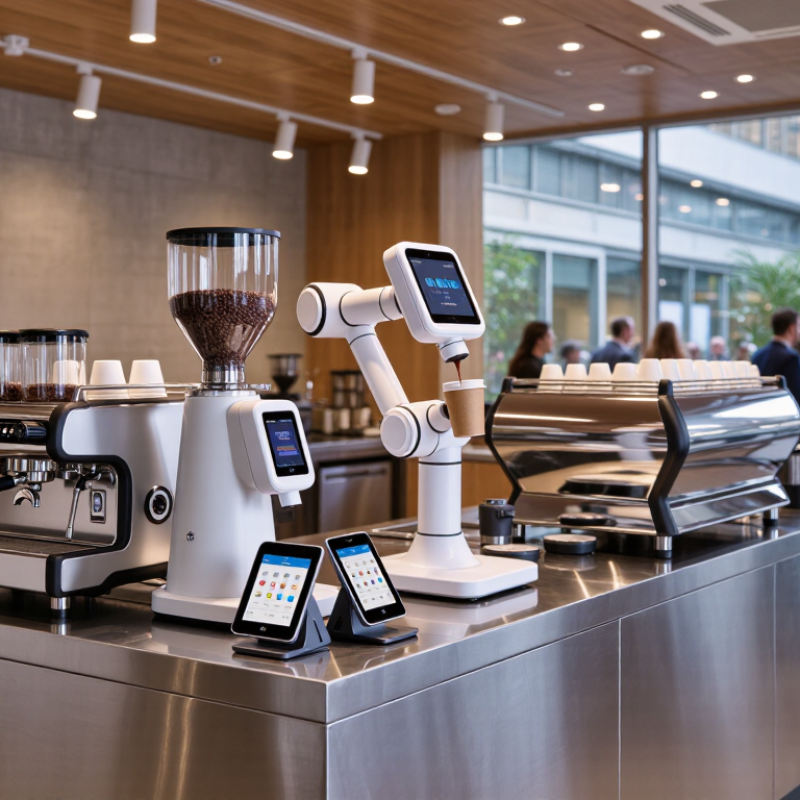
China’s black coffee robotics sector covers more than robotic baristas. It includes automated espresso stations, bean grinders, dosing units, brewing modules, cup handling, and payment systems. These systems mainly serve offices, transport hubs, hotels, convenience stores, and unattended kiosks.
The International Federation of Robotics reported 276,288 industrial robot installations in China during 2023. That represented about 51% of global installations.
This manufacturing base supports precise motors, sensors, machine vision, and robotic arms for coffee equipment. The International Federation of Robotics also identifies professional service robots as a growing automation field. However, coffee machines need different strengths.
Food-safe materials, stable water temperature, accurate extraction, and quick cleaning matter more than speed alone. Black coffee products usually include espresso, Americano, long black, and filter-style drinks. Milk systems are optional, not essential. This distinction affects supplier selection and machine design.
Tips: Compare suppliers by product category, not impressive demonstrations. Ask for extraction consistency after heavy daily use. Request data on brewing temperature, drink time, cleaning cycles, and failure rates. A supplier may show a perfect cup, but real locations produce dust, vibration, and uneven beans. That weakness deserves attention. Reports from the China Coffee Association and market research firms indicate continued growth in domestic coffee consumption, yet public statistics often combine manual and automated sales. Buyers should treat market forecasts carefully and verify operating data directly.
Ranking China’s top ten black coffee robotics suppliers requires more than counting installations. The evaluation should begin with verified brewing performance: dose accuracy, water temperature stability, extraction time, and cup consistency. Independent tasting panels can compare bitterness, aroma, and body across repeated cycles. One test is not enough. Real expertise appears in the details.
A strong supplier should provide documented factory quality controls, electrical safety compliance, traceable components, and clear maintenance procedures. Assess each system as a complete operating platform, including grinder calibration, bean loading, cleaning alerts, payment integration, and remote diagnostics. Field evidence matters more than polished demonstrations. Review uptime logs from busy locations, service response times, spare-parts availability, and technician training. Suppliers with measurable acceptance standards deserve higher scores.
The ranking should also measure commercial fit. Compare purchase cost, energy use, consumable waste, labor savings, warranty coverage, and expected service life. A supplier may offer impressive automation but weak local support. That weakness should reduce its position. However, public data is often incomplete, and some performance claims remain difficult to reproduce. A transparent scoring model should disclose test conditions, sample size, weighting, and conflicts of interest. Regional customization also matters, especially for water quality and cleaning routines. The final list should remain reviewable, not permanent.
China’s top ten black coffee robotics suppliers reflect a wide range of automation expertise. Some build robotic café cells for shopping centers and offices. Others focus on compact vending machines for transport hubs and factories. Several suppliers specialize in robotic arms, while others develop grinders, brewers, payment systems, and remote monitoring together. Their strongest profiles usually show stable extraction, accurate dosing, easy cleaning, and reliable after-sales support.
A serious comparison should examine production experience, testing records, and service coverage. Many professional recipes use about 18 grams of coffee and extraction near 25 to 30 seconds. The exact settings still depend on the beans, grinder, and water quality. Stainless steel contact parts can support hygiene and durability. Vision sensors may improve cup placement, but poor calibration can create costly errors. This is where supplier claims need careful checking. A polished demonstration is not enough.
Tips: Ask for live operating data, not only showroom videos. Check cleaning time, spare-part availability, software updates, and technician response. Request a pilot installation with real users and local water conditions. Small faults matter. A machine that loses temperature during a busy morning may damage customer trust quickly. Supplier profiles should also explain customization limits, training plans, energy use, and warranty terms. Some evaluations remain imperfect because long-term field data is not always publicly available.
China’s top ten black coffee robotics suppliers should be compared through measurable capabilities, not attractive catalog images. Experienced buyers should inspect brewing consistency, robotic movement, heating control, and cleaning access. A reliable system can dose beans accurately, manage water temperature, and repeat each recipe with limited human adjustment. Some suppliers offer vision sensors for cup placement and automated dispensing. Others focus on compact robotic arms for kiosks, offices, and high-volume service areas. The difference appears during busy periods.
Automation features deserve practical testing. Ask whether the machine supports remote monitoring, alarm notifications, recipe permissions, and production records. A clear interface helps staff correct errors quickly. Contactless payment integration may improve workflow, but compatibility should be verified before installation. Safety sensors, emergency stops, and food-contact materials also require documented inspection. Do not accept vague claims about “full automation.”
Service capability often determines the real operating cost. Compare installation training, spare-parts availability, response times, software updates, and technician coverage across regions. Request evidence from similar commercial deployments, including maintenance logs and beverage output data. A supplier with strong engineering knowledge should explain failure risks without hiding limitations. Remote support is useful. It is not always enough. Some systems still need local technicians for grinder wear, pump faults, or calibration drift. Buyers should also test cleaning procedures with actual staff, because complicated routines are often ignored after launch. Even a well-designed shortlist can be imperfect when site conditions, water quality, and customer traffic change.
Comparison of technology maturity, automation features, and service capabilities
The chart uses a normalized 0–100 benchmark based on practical commercial coffee-robotics capabilities, including recipe control, multi-beverage automation, cleaning functions, remote monitoring, customization, installation, maintenance, and after-sales support. Supplier identities are intentionally anonymized, and the scores are comparative capability indexes rather than revenue or market-share figures.
China Top 10 Excitech Robot Suppliers?
How to Select a Suitable Excitech Robot Supplier in China
Selecting a black coffee robotics supplier requires more than comparing prices. Check how the system handles grinding, dosing, brewing, cup delivery, and cleaning. Ask for measured data on temperature stability, extraction time, serving speed, and daily operating capacity. A supplier should explain these figures clearly, not hide behind broad promises.
Request a live factory demonstration or an independent trial. Observe the machine during repeated orders, especially when the grinder heats up or ingredients change. Review electrical safety documents, food-contact material records, software protection, and export experience for your target market. Also inspect assembly quality, spare-part availability, remote diagnostics, and technician response times. Small delays can stop a busy café.
Do not ignore customization. The supplier must match your menu, counter space, payment system, water supply, and cleaning routine. A pilot order is safer than a large commitment. Compare at least three technical proposals using the same requirements. The cheapest option may bring higher maintenance costs later. That lesson is easy to miss. A detailed checklist helps, but it cannot replace direct testing. Ask existing customers about downtime, calibration support, and unresolved service cases. Honest answers are often more valuable than polished presentations.
| Rank | Anonymous Supplier Profile | Core Excitech Robot Focus | Typical Configuration | Indicative Output Range | Customization Capability | Documentation to Request | Commercial Lead Time | Warranty Benchmark | After-Sales Support | Selection Score |
|---|---|---|---|---|---|---|---|---|---|---|
| 1 | Supplier Profile 01 High-volume automatic coffee equipment specialist |
Fully automatic black coffee dispensing, grinding, brewing and cup delivery | Fresh-bean grinder, programmable brewer, water filtration interface, touchscreen control | 80–150 cups/hour, depending on recipe and cup size | HighRecipe software, cabinet finish, payment interface and language options | CE technical file, electrical safety report, food-contact declarations, user manual and spare-parts list | 30–60 days for standard configurations | 12 months for manufacturing defects | Remote diagnostics, video training and replaceable module support | 92/100 |
| 2 | Supplier Profile 02 Commercial bean-to-cup automation manufacturer |
Office, hotel and convenience-store black coffee automation | Bean hopper, burr grinder, automatic tamping, extraction unit and self-cleaning cycle | 60–120 cups/hour | HighBrand-neutral enclosure, menu programming and remote monitoring integration | CE or destination-market compliance documents, HACCP-related cleaning instructions and wiring diagrams | 35–70 days | 12–18 months, subject to contract terms | Online troubleshooting, technician training and common maintenance kits | 90/100 |
| 3 | Supplier Profile 03 Robotic café-cell integration supplier |
Robotic arm operation combined with espresso or filter coffee equipment | Six-axis robotic arm, coffee machine, cup dispenser, safety enclosure and PLC control | 40–100 cups/hour | Very HighRobot movement, workstation layout, recipes and system integration | Risk assessment, emergency-stop circuit details, CE documentation and robot maintenance schedule | 60–120 days for engineered projects | 12 months, with optional extended service package | Commissioning support, remote PLC assistance and on-site installation options | 88/100 |
| 4 | Supplier Profile 04 Compact self-service coffee kiosk supplier |
Small-footprint automated black coffee kiosks for retail and transport locations | Compact brewer, internal water tank or mains connection, cup holder and payment-ready controller | 30–80 cups/hour | Medium–HighCountertop dimensions, exterior graphics, menu settings and payment compatibility | Electrical schematics, cleaning procedures, food-contact material information and packing specifications | 25–55 days | 12 months | Spare-parts supply, remote video support and operator training materials | 86/100 |
| 5 | Supplier Profile 05 Fresh-ground coffee vending automation supplier |
Unattended vending with fresh grinding and automated cup dispensing | Bean storage, grinder, brewer, cup dispenser, waste container and cashless payment interface | 50–100 cups/hour | Medium–HighVending cabinet, payment system, telemetry and recipe library | Machine safety file, sanitation requirements, connectivity specifications and component certificates | 45–90 days | 12 months | Remote alerts, preventive-maintenance schedule and field-service coordination | 84/100 |
| 6 | Supplier Profile 06 Automatic filter-coffee system supplier |
Batch-brew and portioned black coffee systems for high-throughput locations | Brewing chamber, thermal holding unit, programmable dosing and automatic rinse cycle | 60–180 cups/hour, depending on batch size | MediumBrewing capacity, dispensing height, holding configuration and control panel language | Brewing performance data, cleaning validation, electrical documentation and installation requirements | 30–60 days | 12 months | Operator training, consumable guidance and scheduled replacement-part support | 82/100 |
| 7 | Supplier Profile 07 Modular coffee automation OEM |
OEM modules for grinding, dosing, brewing and beverage dispensing systems | Separate grinder, brewer, controller and dispensing modules for system integration | 40–120 cups/hour, depending on system design | Very HighMechanical interfaces, software protocols, electrical voltage and enclosure design | Interface drawings, protocol documentation, component traceability and food-contact declarations | 45–100 days | 12 months | Engineering consultation, sample-unit testing and integration assistance | 80/100 |
| 8 | Supplier Profile 08 Smart coffee station supplier |
Connected coffee stations with digital ordering and machine-status monitoring | Automatic brewer, touchscreen, cloud dashboard, QR payment compatibility and usage records | 40–90 cups/hour | HighInterface language, cloud functions, menu control and customer-flow design | Cybersecurity statement, connectivity requirements, software terms, electrical documents and cleaning guide | 40–80 days | 12 months, with software support defined separately | Cloud monitoring, firmware support and remote service-ticket handling | 79/100 |
| 9 | Supplier Profile 09 Custom robotic beverage workstation supplier |
Made-to-order robotic workstation for cafés, exhibitions and hospitality venues | Collaborative robot, automatic brewer, cup handling, safety sensors and custom HMI | 25–70 cups/hour | Very HighLayout, robot sequence, cup size, recipe logic and customer interaction | Machine risk assessment, safety validation, robot manuals, electrical drawings and acceptance-test plan | 75–150 days | 12 months, normally project-specific | On-site commissioning, operator instruction and customized maintenance contract | 77/100 |
| 10 | Supplier Profile 10 Entry-level automated coffee machine supplier |
Basic automated black coffee dispensing for small offices and low-volume retail | Compact grinder or soluble-coffee module, programmable water dosing and simple control panel | 20–60 cups/hour | MediumExterior color, menu configuration, voltage and payment-interface options | User manual, cleaning schedule, electrical safety documents, spare-parts catalogue and warranty terms | 20–45 days | 12 months | Email support, online manuals and standard spare-parts availability | 74/100 |