
14, Raghava Enclave, Transport Road, Secunderabad, Hyderabad (500009)
©2024 All Rights Reserved by excitechrobot.com
Warehouse work is changing at floor level: autonomous mobile robots move totes between zones, while autonomous forklifts handle pallets beneath high racks. The category is broad. “Autonomous Warehouse Robots” can describe machines with very different payloads, navigation systems, and safety requirements.
Industry data shows why businesses are paying attention. MHI’s 2024 Annual Industry Report found that 55% of surveyed supply chain leaders planned to invest in robotics and automation. The International Federation of Robotics reported 4.28 million industrial robots operating worldwide in 2023. That figure spans industries, not warehouses alone, so it should not be mistaken for a warehouse-robot count. Still, it signals a wider shift toward automation.
People remain central. Tye Brady, Amazon Robotics’ chief technologist, has said, “We don’t believe in replacing people with robots. We believe in people and robots working together.” That idea matters in a busy facility, where workers still resolve exceptions, replenish stock, and make judgment calls. Robots can reduce repetitive travel, but they cannot fix a poorly planned workflow by themselves.
No single model fits every warehouse. A compact mobile robot may suit a narrow picking aisle; a pallet-moving unit may be better for dock-to-storage runs. Battery life, fleet software, integration costs, and human traffic all deserve close scrutiny. Some details are easy to overlook.
This guide compares seven leading options for business use. It focuses on practical fit, not just impressive demonstrations, so buyers can weigh each robot against real operating needs.
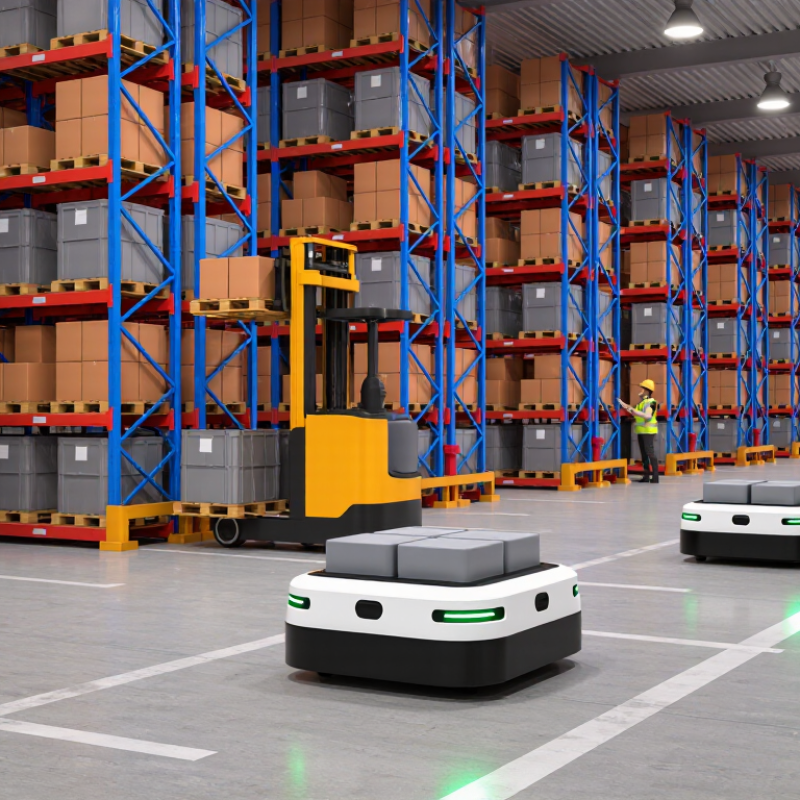
Autonomous warehouse robots help move inventory through receiving, storage, picking, and dispatch. Depending on their design, they may carry totes, transport pallets, or support workers at picking stations. A mobile robot can follow mapped routes while sensors detect people, carts, and unexpected obstacles. That matters in a busy aisle where a dropped carton can change the safest path. Small delays add up.
In practice, these robots work best when tasks, traffic rules, and handoffs are clearly defined. Warehouse teams can track travel time, completed moves, and blocked routes to spot problems early. Integrating robot software with inventory and order systems can reduce manual updates, but poor data can still send work to the wrong location. That part is easy to underestimate.
Staff also need time to learn exception handling, such as clearing a route or responding to a misplaced item. Robots can improve consistency, but they do not fix every process. A careful site assessment and a limited pilot can reveal whether the layout, workload, and safety procedures are ready.
Some lessons will be inconvenient. That is useful, too.
Autonomous warehouse robots navigate by combining a digital map with real-time sensor readings. Cameras, lidar, or other sensors help them detect aisle edges, people, pallets, and unexpected obstacles. The robot compares what it sees with its route and adjusts its position as conditions change. Maps are never quite finished. A relocated rack or a stretch-wrapped pallet can create a small mismatch, so teams should review routes after layout changes.
Movement depends on the task and the floor. Some robots travel beneath carts, while others carry shelves or transport pallet loads. They use controlled acceleration and braking to reduce shifting, especially near corners and busy crossings. Speed matters, but predictable movement matters more. In a narrow aisle, a robot may pause and request a clear path instead of squeezing past a worker. That pause can slow a pick run; it can also prevent a minor obstruction from becoming a larger problem.
Goods handling starts with matching the robot’s capacity and attachment to the load. Sensors can check position or detect an unstable pickup, but they do not replace sound packaging and clear operating procedures. Staff should test handoff points with real cartons, including uneven loads and scuffed labels. Edge cases are easy to overlook. A system that handles standard totes smoothly may still need adjustment for a leaning box or an unusually crowded staging area.
Representative payload ratings illustrate how different autonomous robot classes move goods through a warehouse.
Payload capacity varies by model and operating conditions. These values are illustrative reference points, not specifications for a particular product. Navigation commonly combines sensors such as lidar or cameras with mapping and obstacle detection.
Choosing an autonomous warehouse robot starts with the work, not the machine. Map the routes it must travel, from receiving docks to packing stations. Measure aisle widths, turning space, floor transitions, and the narrowest doorway. Check typical loads, peak loads, and how often workers share each route. A robot that handles the average load may struggle with a full pallet. Fit matters. Confirm that the system can exchange task and inventory data with your existing warehouse software. Ask how it behaves when a route is blocked or a network connection drops.
Run a pilot in a representative area, including busy shifts and ordinary interruptions. Track completed trips, waiting time, missed tasks, and manual interventions. Ask operators where the robot slows them down; their observations may reveal problems a dashboard misses. Review battery routines, charging locations, maintenance access, and support response times. A polished demonstration is useful, but it is not proof of reliable performance. Pilot data can be messy, too, so agree on measurement rules before testing and revisit them if they do not reflect daily work.
Tips: Mark a short test route with floor tape, then watch a full shift. Test loaded and empty runs. Leave room for surprises. A pilot may expose assumptions your team did not know it had.
Seven Warehouse Robots for Different Business Needs
Warehouse automation works best when each robot solves a specific bottleneck. The International Federation of Robotics reported about 113,000 sales of transport and logistics robots in 2023, a 35% annual increase. That growth is notable, but a busy warehouse still needs a careful fit. Tote-carrying autonomous mobile robots suit repeated trips between picking zones. Goods-to-person systems bring shelves or bins to stationary workers, reducing walking in high-volume operations. For bulk movement, pallet-moving robots can shuttle loads between receiving, storage, and dispatch.
Different jobs need different machines. Autonomous forklifts handle pallet transport in mapped aisles, but floor conditions and mixed foot traffic matter. Robotic arms can pick cases or sort cartons when product sizes stay reasonably consistent. Inventory drones scan high racks quickly, though reflective wrapping and crowded spaces can affect readings. Cleaning robots cover broad floor areas after shifts; they do not replace spill checks or maintenance. Not every aisle. A poor layout can limit even capable equipment.
The IFR figures describe a growing category, not a guarantee of savings for any single site. Start with a measured task: count pallet trips, walking time, or stock discrepancies across a normal week. Pilot one robot type in a defined zone, then compare travel time, uptime, and exceptions. Fit matters. Keep manual routes accessible, and review how workers interact with moving equipment; real warehouses are rarely as tidy as a floor plan.
Planning a warehouse robot fleet starts with the work, not the machines. Map the repeatable routes: receiving bays, replenishment aisles, packing stations, and charging points. Record travel times, blocked paths, peak-hour queues, and handoffs to staff. Small tests matter. A robot that saves distance on paper may still create congestion beside a busy pick face.
Budget for more than hardware. Assess floor conditions, Wi-Fi coverage, safety procedures, warehouse software interfaces, battery charging, and support for maintenance. MHI’s 2024 Annual Industry Report found that 55% of surveyed supply-chain leaders planned to increase technology investment. That signals interest, not guaranteed returns. Set a baseline before the pilot, then compare completed tasks, idle time, exceptions, and labor hours against it.
Start with a limited fleet and one measurable workflow, such as moving totes between picking and packing. Gartner forecast that 75% of large enterprises would adopt some form of intralogistics smart robots by 2026. Treat that as a forecast, not proof that every site is ready. Expand only when workers can safely share routes and supervisors can resolve stalled missions. The awkward truth: early results often depend on tidy processes that the live warehouse does not have. Plan for that gap.
| Robot type | Typical warehouse task | Indicative payload | Common navigation approach | Best operational fit | Integration planning priority |
|---|---|---|---|---|---|
| Shelf-moving goods-to-person AMR | Moves storage racks or shelving units to stationary picking stations. | About 500–1,000 kg per robot, depending on design. | Laser-based mapping, cameras, and onboard safety sensors. | High-volume piece picking with repeatable storage locations. | Plan station placement, rack compatibility, charging, and order-release logic. |
| Tote- and case-transport AMR | Carries totes, cartons, or picked orders between work areas. | About 100–600 kg per robot; varies by platform and load carrier. | Lidar, cameras, and mapped routes with dynamic obstacle detection. | Order picking, replenishment, and short-distance goods movement. | Define tote sizes, handoff points, traffic rules, and task priorities. |
| Pallet-moving AMR | Moves pallets between staging areas, production lines, and dock zones. | About 600–1,500 kg per robot; some configurations support more. | Lidar or camera-based localization; some sites also use floor markers. | Repetitive pallet transfers on defined routes. | Check pallet condition, pickup geometry, floor quality, and crossing points. |
| Autonomous counterbalance forklift | Transports and places pallet loads, including floor-level and dock transfers. | Common forklift capacity classes include roughly 1,000–2,500 kg. | Lidar, cameras, safety scanners, and mapped operating zones. | Facilities with frequent pallet handling and suitable aisle widths. | Validate load sizes, turning space, pedestrian separation, and dock interfaces. |
| Autonomous reach truck | Transfers pallet loads into and out of elevated storage positions. | Often around 1,000–2,000 kg; capacity can decrease at greater lift heights. | Lidar and camera sensing, with localization support for rack aisles. | High-bay storage where vertical space is important. | Survey rack geometry, floor tolerances, load overhang, and aisle clearances. |
| Mobile robotic picking arm | Picks or sorts suitable items from bins, totes, or conveyors while moving between work areas. | Arm payloads commonly range from a few kilograms to around 20 kg. | Mobile-base localization paired with 3D vision or other item-detection sensors. | Structured picking or sorting of items with predictable presentation. | Test item variability, grasp success, exception handling, and safe access to workstations. |
| Autonomous inventory-scanning robot | Captures shelf, barcode, or RFID data during scheduled aisle patrols. | Designed for sensor equipment rather than material transport. | Lidar or camera localization with barcode, image, or RFID sensing. | Cycle counting and inventory visibility across large storage areas. | Align scan schedules and data fields with inventory records and exception workflows. |
Fleet planning checklist: map travel paths and shared zones, estimate peak task demand, confirm wireless coverage and charging capacity, connect the fleet manager to warehouse execution systems, and pilot the workflow before scaling.